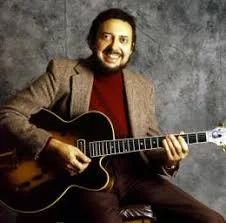
Barney Kessel
Barney Kessel was one of the most accomplished bebop jazz guitarists of the 1950s and 1960s, voted best jazz guitarist in DownBeat magazine multiple times, and a massively influential session musician who played on hundreds of hit recordings in Hollywood. He was Charlie Parker's preferred guitarist for small-group sessions, a member of the Oscar Peterson Trio in the early 1950s, and simultaneously one of the busiest Hollywood session guitarists — playing on Frank Sinatra, Ricky Nelson, and Beach Boys recordings. His guitar technique combines bebop fluency with a warm, robust tone from the Gibson ES-350 that defined the post-Charlie Christian electric jazz guitar sound.
Full, warm jazz guitar tone — Kessel's sound is rich and direct, with a slightly round attack from his plectrum approach that differs from the thumb-plucked smoothness of Montgomery. His bebop lines are precise and rhythmically sophisticated, with a light swing that makes complex passages feel effortless. The ES-350's humbucker pickups through clean amplification produce the warm, full-frequency jazz guitar standard.
Signal Chain Order
Why Barney Kessel's Rig Works
Kessel's plectrum-driven approach, rather than the thumb-picking technique of contemporaries like Wes Montgomery, produces a distinctly different attack character — a pick strikes with more immediate, defined transient energy than a thumb's softer contact, which suits Kessel's precise, rhythmically sophisticated bebop lines where crisp articulation of fast, harmonically complex runs matters more than the rounder, hornlike sustain Montgomery's thumb-picking produces.
The ES-350's full-hollow 17-inch body, larger than many jazz archtops, contributes substantial natural acoustic resonance that carries through the amplified signal, giving Kessel's tone a warmth and complexity that a smaller-bodied or semi-hollow guitar wouldn't produce as fully — that resonance is part of why his tone reads as rich and full-frequency even in the demanding context of hundreds of hit session recordings where his guitar had to sit well against orchestral and vocal arrangements.
His simultaneous careers as elite bebop soloist and prolific Hollywood session musician demanded a tone versatile enough to work in radically different contexts — pure jazz combo one day, a Frank Sinatra orchestral session or Beach Boys pop record the next — and the ES-350's warm, clean, unprocessed character (with essentially no gain or effects) is exactly the kind of transparent, adaptable tone that translates across that range of musical settings without needing to be reconfigured.
Guitars
Gibson ES-350
1952–1975Kessel's primary guitar through his peak period — the ES-350's 17-inch full-hollow body and P-90 then humbucker pickups produce a warm, projecting jazz tone. He plays from the neck pickup, maintaining the warm, round character of his predecessor Charlie Christian's ES-150 tone.
Kay Barney Kessel Signature
1957–1968An unusual entry-level signature model — Kay built an affordable signature guitar for Kessel that reached many students. The Kay's less refined construction produces a rougher tone than the Gibson but brought his name to a mass-market instrument.
Amplifiers
Fender Twin Reverb
1963–1990The Twin for clean jazz amplification — its headroom ensures no accidental breakup under hard playing. The spring reverb is used at low settings for very subtle dimension.
Amp guide →Effects Pedals
Key Albums & Tone
Debut Contemporary Records album — Kessel's bebop vocabulary in a trio context. The Gibson ES-350 through clean amplification: warm, swinging, harmonically sophisticated. The full-hollow body's natural resonance is audible even through amplification.
The "Poll Winners" trio — the first of several albums with Manne and Brown. Kessel's guitar in a front-line role alongside drums and bass, demonstrating the range of his bebop vocabulary across standards and original compositions.
Frequently Asked Questions
What guitar does Barney Kessel use?
Gibson ES-350 and Kay Barney Kessel Signature. Kessel's primary guitar through his peak period — the ES-350's 17-inch full-hollow body and P-90 then humbucker pickups produce a warm, projecting jazz tone. He plays from the neck pickup, maintaining the warm, round character of his predecessor Charlie Christian's ES-150 tone.
What amp does Barney Kessel use?
Fender Twin Reverb. The Twin for clean jazz amplification — its headroom ensures no accidental breakup under hard playing. The spring reverb is used at low settings for very subtle dimension.
What pedals does Barney Kessel use?
Barney Kessel does not use effects pedals.
What is Barney Kessel's signature sound?
Full, warm jazz guitar tone — Kessel's sound is rich and direct, with a slightly round attack from his plectrum approach that differs from the thumb-plucked smoothness of Montgomery. His bebop lines are precise and rhythmically sophisticated, with a light swing that makes complex passages feel effortless. The ES-350's humbucker pickups through clean amplification produce the warm, full-frequency jazz guitar standard.
About This Data
Gear information for Barney Kessel is compiled from live performance footage, rig-rundown interviews, manufacturer and signature-model documentation, and cross-referenced guitar press coverage — not a single source. Where accounts conflict (a common issue with decades-old gear history), we favour the version corroborated by the most independent sources and note genuine ambiguity in the text rather than presenting a guess as settled fact.
This page is maintained by Alex Hall, last reviewed July 2026. Spotted something out of date or inaccurate? Let us know — corrections are usually made within a few days.