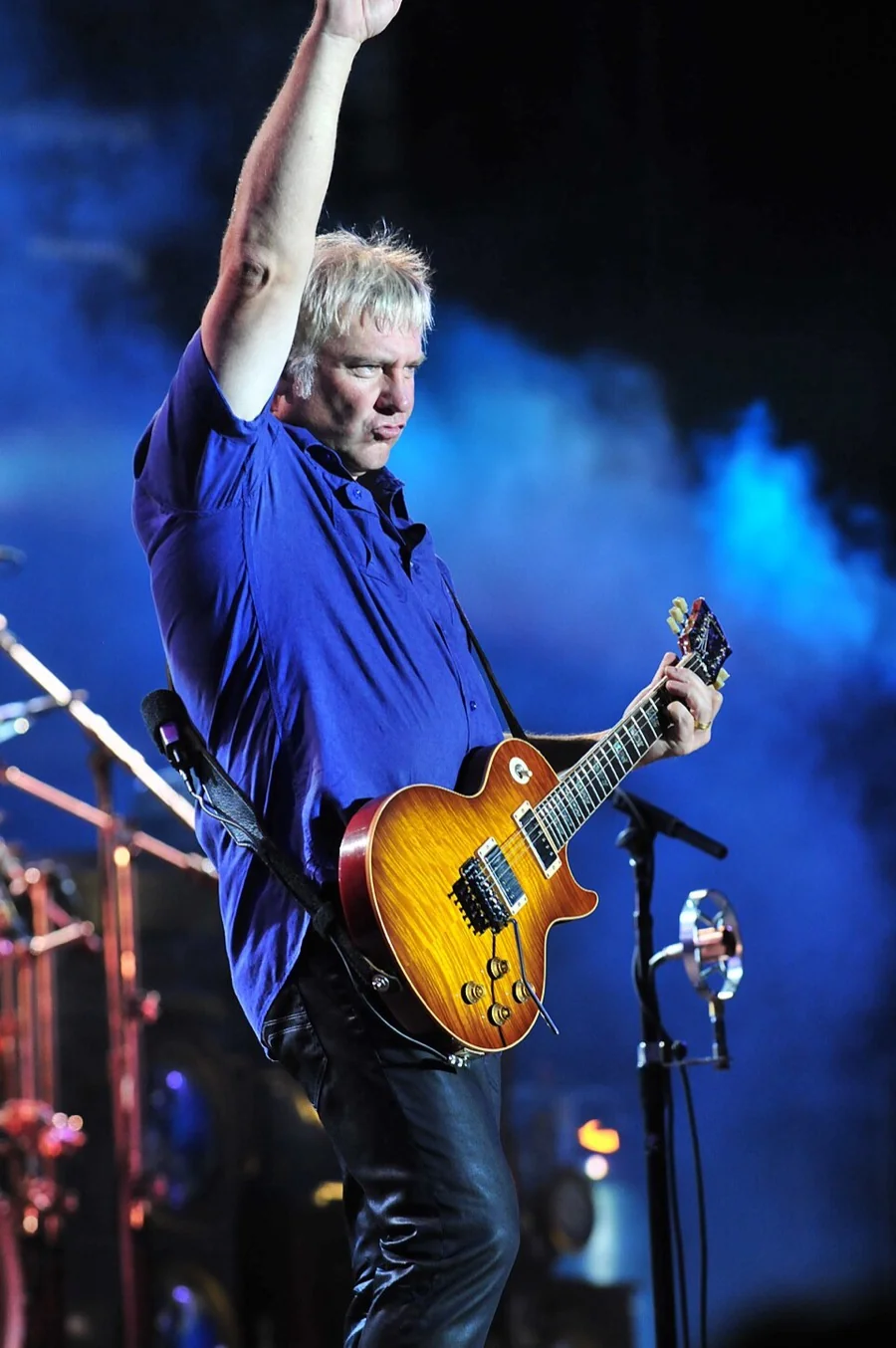
Alex Lifeson — Rig Network
12 gear items · 60 artist connections · Alex Lifeson profile
Guitars
Used extensively through 'A Farewell to Kings', 'Hemispheres' and 'Permanent Waves'. The semi-hollow body's warmth and resonance shape Lifeson's clean tones; the f-holes add slight feedback sensitivity that he exploits for sustain.
Primary guitar through '2112' and the mid-1970s heavy period. The Les Paul's humbuckers through a cranked Marshall produce the thick, dominant rhythm tone on '2112' and 'Working Man'.
PRS became his primary instrument from the Counterparts era forward — the Custom 24's wide tonal range suits the diverse sonic demands of later Rush material.
Used during the synth-heavy 1980s period — the Strat's single-coil brightness cuts through the dense keyboard layers of Signals and Grace Under Pressure.
Amplifiers
The foundation of Lifeson's 1970s heavy tone — stacked Marshall JMPs at stage volume with the characteristic EL34 crunch. Run reasonably clean and pushed with pedals rather than dimed.
Used alongside Marshalls for clean headroom — the Hiwatt's higher clean ceiling provides the platform for chorus-drenched clean passages while the Marshall handles gain.
The Boogie's cleaner, tighter gain character suited the more polished production of Permanent Waves and Moving Pictures — less Marshall bloom, more articulate note definition.
Pedals & Effects
Lifeson's most defining pedal — the CE-2 is on for virtually every clean passage. It adds a shimmering, three-dimensional quality to arpeggios that defines the Rush sound on 'Subdivisions', 'Limelight', and most 1980s material. Set at moderate rate and depth.
Digital delay for rhythmic textural layers — Lifeson uses delay as a compositional tool, setting it to dotted-eighth rhythms that create interlocking guitar patterns over the bass and drums.
Phase 100 on 'A Farewell to Kings' and 'Hemispheres' — the slower settings add a breathing, organic quality to sustaining chord passages.
Used on early Rush recordings for thick, saturated lead tones before Marshall breakup became his primary gain source.
Wah used selectively for dramatic effect — Lifeson is not a wah-heavy player but deploys it on specific solo passages for expressive vowel-like sweeps.
Most Similar Rigs
Artists who share the most actual gear with Alex Lifeson — ranked by equipment overlap.